Expected Value and Variance
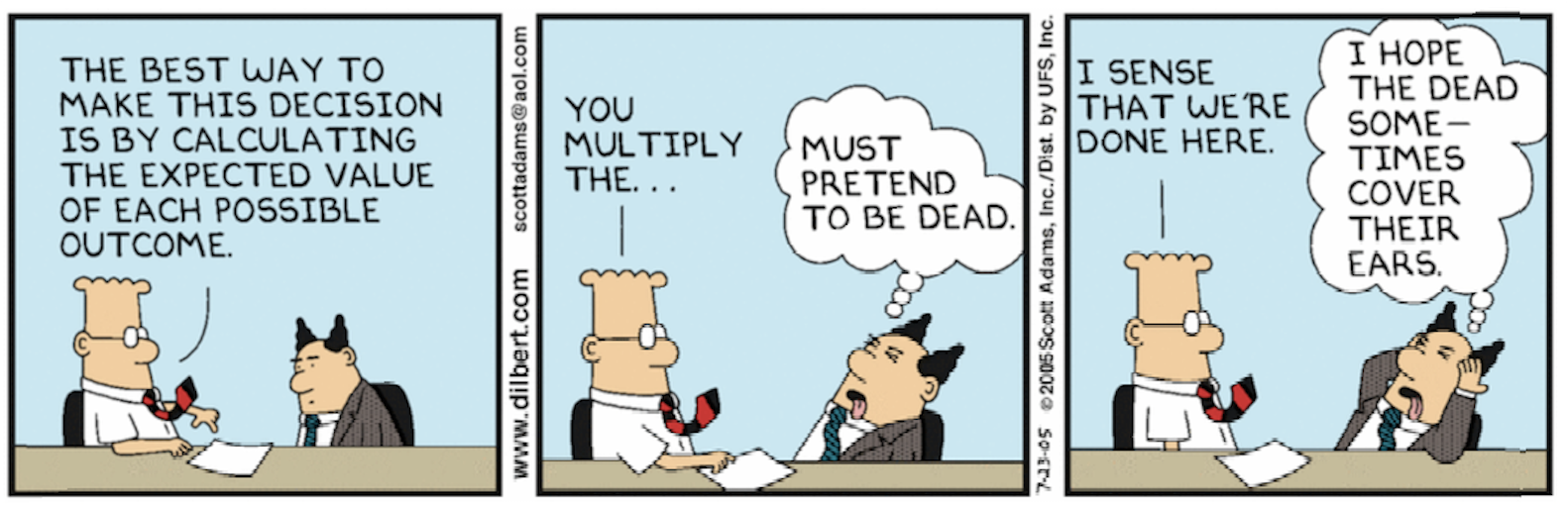
What is wrong with this comic?
Perhaps your feelings align with the pointy-haired man’s, but there is something wrong with Dilbert’s statement. Can you tell what is wrong?
Warmup
15:00
15:00
Comparing expected values
\(T\) is a random variable with the distribution shown below:
\[ T = \begin{cases} 3, & \text{with prob } 1/3\\ 4, & \text{with prob } 1/4\\ 5, & \text{with prob } 5/12 \end{cases} \]
\(T\) is a random variable that takes the value \(3\) with probability \(1/3\), the value \(4\) with probability \(1/4\), and the value \(5\) with the remaining probability.
Now consider the box with tickets: \(\boxed{3}\, \boxed{3}\, \boxed{3} \,\boxed{4} \,\boxed{4} \,\boxed{4} \,\boxed{4} \,\boxed{5} \,\boxed{5}\, \boxed{5} \,\boxed{5} \,\boxed{5}\)
Suppose we draw once from this box and let \(U\) be the value of the ticket drawn. Fill in the blank with “less than”, “greater than”, or “equal to”:
The expected value of \(T\) is ____ the expected value of \(U\).
The expected value of \(T\) is less than the expected value of \(U\). You don’t need to do the computation, but just note that \(U\) has a higher chance of being 4 than \(T\), and a correspondingly lower chance of being \(3\) (they both have the same probability of being \(5\)), so \(U\) is greater, on average.
Office hours and the Poisson distribution
A prof notices that their office hours are not too crowded this semester. They observe that a random variable \(X\) representing the number of Stat 20 students coming to their weekly office hours has a Poisson(2) distribution. Furthermore, there is one Data 88 student from a previous semester who is always there (they want a letter of recommendation).
Let \(V\) be the total number of students in their office hours. What are the expected value and variance of \(V\)?
Let \(X\) be the number of Stat 20 students who go to the office hours. Then \(E(X) = 2 = Var(X)\). But the number of students in the office is \(X+1\) since that one Data 88 student is always there. \(E(X+1) = 2+1 = 3\) and \(Var(X+1) = Var(X) = 2\) (since adding a constant doesn’t change the spread)
What does squaring do to the expectation and variance?
Let \(X\) be a discrete uniform random variable on the set \(\{-1, 0, 1\}\).
If \(Y=X^2\), what are \(E(Y)\) and \(Var(Y)\)?
If \(X\) takes the values \(\{-1, 0, 1\}\) with equal probability, then \(E(X) = 0\) and \(Var(X) = E(X^2) -0^2 = E(X^2) = 2/3\). If \(Y=X^2\), \(E(Y) = E(X^2) = 2/3\) and \(Var(Y) = 2/3 - 4/9 = 2/9\)
Minimum function
The minimum function \(\min(a,b)\) takes in two numbers \(a\) and \(b\) and outputs the smaller of the two. Let \(X\) be a discrete uniform random variable on the set \(\{-1, 0, 1\}\).
If \(W = \min(X, 0.5)\), what is \(E(W)\)?
\(E(W) = -1/6\)
Worksheet: Expected Value and Variance
25:00
Break
05:00
Lab 7
25:00